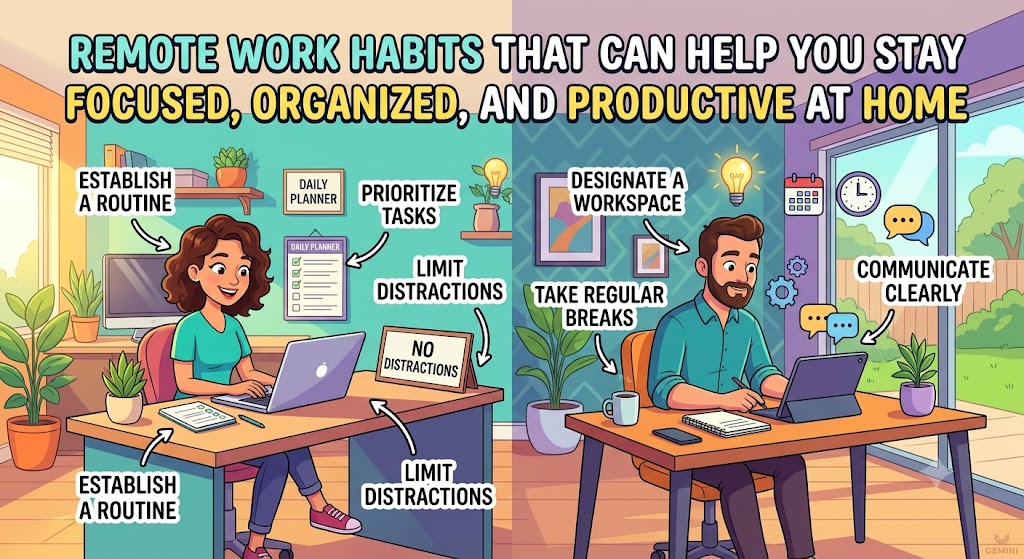
Working from home can offer flexibility and comfort, but productivity becomes much easier when your day has a few dependable routines behind it.
Working from home sounds simple until the boundaries between professional responsibilities and everyday life begin to disappear. At an office, the environment itself creates a natural signal that it is time to work. At home, the same room may contain your desk, television, kitchen, personal devices, household tasks, and dozens of possible distractions. Without a basic structure, even a full day at home can end with the feeling that very little was actually accomplished.
Productive remote work is not necessarily about working longer. In many cases, it is about making the hours you already have more intentional. A predictable morning routine, a realistic task list, an organized workspace, and deliberate breaks can create a much stronger foundation than simply trying to stay busy.
The best habits are also practical enough to maintain. You do not need a complicated productivity system or a perfectly designed home office. What matters is creating an environment and routine that make it easier to start, concentrate, finish important work, and properly disconnect at the end of the day.
Give your brain a consistent signal that the workday has begun.
Know which tasks deserve your best attention before distractions appear.
Reduce interruptions during the periods when deeper work is required.
Create a Clear Start to the Day
One of the most useful remote-work habits is having a consistent beginning to the workday. This does not have to be an elaborate morning ritual. It might simply mean getting dressed, preparing a drink, reviewing the day’s calendar, and sitting down at your workspace at roughly the same time.
The goal is to create a transition between personal time and professional time. If you immediately open work messages while still dealing with breakfast, household chores, or personal notifications, the day can begin in a reactive state. A short preparation period gives you a chance to decide what deserves attention rather than allowing the first notification to determine your priorities.
Use a Short, Realistic Daily Plan
A massive task list can create the illusion of organization while actually making the day feel overwhelming. Instead, identify a small number of meaningful priorities. These are the tasks that would make the day feel productive even if several smaller items had to wait.
You can then divide those priorities into smaller actions. Rather than writing “finish project,” write the specific next step, such as reviewing the available information, preparing a first draft, checking the figures, or sending the completed version for review. Smaller actions reduce friction and make it easier to begin.
Design Your Workspace for Fewer Decisions
A useful home workspace does not need expensive furniture or a magazine-quality appearance. It simply needs to support the work you regularly perform. Keep frequently used items nearby, remove unnecessary clutter, and make sure your computer, charger, notebook, headphones, and other essentials are easy to access.
The advantage of an organized workspace goes beyond appearance. Every small decision you eliminate during the day saves mental energy. When your basic equipment is already in place, you can sit down and begin instead of spending the first several minutes looking for something.
Protect Your Attention From Digital Noise
“`Turn off alerts that do not require immediate attention. Not every message needs to interrupt your concentration.
Checking email and messages at planned times can be more effective than constantly switching between tasks.
If your phone repeatedly pulls your attention away, place it farther from your immediate workspace during focused work.
A cleaner digital workspace can make it easier to identify the task currently receiving your attention.
Work in Focused Blocks Instead of One Endless Session
Long periods of uninterrupted work can be useful for demanding tasks, but expecting yourself to maintain maximum concentration for the entire day is unrealistic. Instead, divide your work into focused periods followed by short breaks.
During a focus block, choose one primary task and avoid unnecessary switching. When the planned period ends, step away for a few minutes. Stretch, refill your water, look away from the screen, or simply move around the room. These small pauses can make it easier to return to the next block with a clearer mind.
Do Not Let Breaks Become Another Source of Distraction
Breaks are valuable, but the activity you choose matters. Opening social media for “just five minutes” can easily turn a short pause into a much longer interruption. A better break is often something that allows your attention to move away from the screen without pulling you into another demanding activity.
Walking around the room, preparing a snack, stretching, getting some fresh air, or simply sitting somewhere different can provide a cleaner mental reset. The objective is not to avoid all entertainment; it is to make sure your break actually helps you return to work.
Keep Household Responsibilities From Taking Over
One of the unique challenges of working at home is the visibility of personal responsibilities. Laundry, dishes, deliveries, cleaning, errands, and other tasks may be physically close even when they are not urgent. If you respond to every small household task during work hours, your attention can become fragmented.
A practical solution is to create specific times for household responsibilities. Some tasks can be handled before work, during a planned lunch break, or after the workday. This creates a clearer boundary and prevents every small chore from becoming a reason to leave the desk.
Know When the Workday Is Finished
Productivity is not only about starting well. Ending the day properly is just as important. When there is no physical commute, it can be tempting to keep checking messages or completing “one last task” late into the evening.
Create a simple closing routine. Review what you completed, identify anything that needs attention tomorrow, tidy your workspace, and close work applications when practical. This gives your mind a clear signal that professional responsibilities are finished for the day.
A Simple Home Productivity Routine
“`The Goal Is Consistency, Not Perfection
A productive remote-work routine should make your life easier, not become another demanding project. Some days will be highly focused, while others will include unexpected calls, personal responsibilities, technical problems, or simple fatigue. A good system should be flexible enough to handle those days.
Start with a few habits that have the biggest effect: begin work at a consistent time, choose clear priorities, keep your workspace organized, protect focused periods, take meaningful breaks, and finish the day deliberately. Once those habits become natural, you can gradually refine your routine around the way you actually work.
A More Sustainable Way to Work From Home
The strongest remote-work habits are rarely complicated. They are small decisions repeated consistently: knowing what matters today, keeping distractions under control, communicating clearly, and giving yourself a defined stopping point.
When your home workspace has structure and your day has a dependable rhythm, productivity becomes less dependent on motivation. You do not need to feel perfectly focused every minute. You simply need a system that helps you return to the right task, manage interruptions sensibly, and keep moving forward. Over time, those ordinary habits can create a remote workday that is more organized, calmer, and considerably more productive.