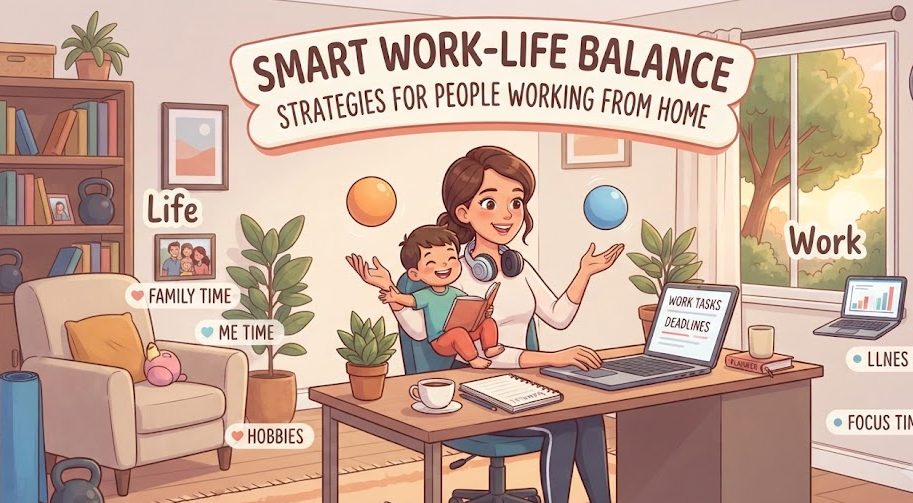
Working from home can make everyday life more flexible, but it can also make the boundary between professional responsibilities and personal time surprisingly difficult to maintain. Without a commute or a physical office closing at the end of the day, work can quietly continue into evenings, weekends, and family time. A thoughtful work-life balance strategy can help people stay productive while still leaving room for rest, relationships, hobbies, and ordinary household responsibilities.
Work-life balance does not mean dividing every day into perfectly equal amounts of work and personal time. Different days naturally have different demands. Instead, the goal is to create a routine where work receives proper attention without permanently taking over the rest of life.
The most effective approach is usually practical rather than complicated. Clear working hours, realistic priorities, regular breaks, organized communication, and a deliberate end-of-day routine can make working from home feel much more manageable.
A good home-working routine should help you finish important work without making yourself permanently available.
Define What Your Workday Actually Looks Like
One of the first steps toward better balance is deciding when work normally begins and ends. Without a basic structure, it is easy to start early, continue through meals, return to unfinished tasks in the evening, and still feel that the workday was incomplete.
Your schedule does not need to follow traditional office hours. Remote work may provide flexibility to accommodate family responsibilities, appointments, or periods when you concentrate best. What matters is establishing a reasonable framework that prevents work from spreading into every available hour.
If your job requires fixed availability, work within those requirements while protecting the time outside them as much as practical.
Start
Choose a realistic time to begin focused work.
Work
Focus on important responsibilities during working hours.
Finish
Create a clear point where professional work ends.
Create a Physical Boundary for Work
A dedicated workspace can provide an important psychological signal that it is time to work. It does not have to be an entire room. A desk, corner, or small workstation can be enough if it is used consistently.
When the workday finishes, leave that area when possible. If the same table must serve multiple purposes, put away work equipment or close the laptop so the visual reminders of unfinished tasks are reduced.
This simple physical transition can be especially useful for people who find themselves thinking about work long after they have stopped working.
Create a “work zone”
Plan Around Priorities Instead of Filling Every Hour
A busy calendar can create the impression of productivity while leaving little room for meaningful work. Instead of scheduling every minute, identify the most important outcomes for the day.
Choose a small number of priorities and leave some flexibility for unexpected requests. A schedule with no empty space can quickly become stressful when a meeting runs late or an urgent task appears.
Planning around priorities also makes it easier to recognize when enough work has been completed for the day.
Try the three-level priority method
Work that genuinely needs attention today.
Useful progress if time permits.
Tasks that can move to another day.
Protect Breaks Instead of Treating Them as Lost Time
Working continuously from morning to evening may seem efficient, but long periods without meaningful breaks can make concentration increasingly difficult. A short pause can provide a useful transition between demanding tasks.
Breaks do not need to be elaborate. Standing up, walking around, preparing water or a meal, looking outside, or briefly stepping away from the computer can help create separation between work periods.
The important part is to make breaks intentional rather than allowing them to become accidental periods of endless social media browsing or unrelated internet activity.
A practical break can include
“`🚶 A short walk or movement around the home
💧 Getting water or preparing a snack
🌿 Spending a few minutes away from the screen
🧘 Quiet time between demanding tasks
“`Set Boundaries Around Messages and Email
Communication tools can make remote work convenient, but they can also create the feeling that you must remain available at all times. An email arriving at 8 p.m. does not necessarily mean it requires an 8 p.m. response.
Establish reasonable expectations about response times whenever your role allows it. You can also use notification settings to reduce interruptions during focused work and outside working hours.
If your team has an established process for urgent matters, make sure you understand it. This allows routine messages to wait without creating unnecessary worry about missing something important.
Remember the difference
You can respond when appropriate.
You feel obligated to respond immediately.
Create a Shutdown Ritual
A clear ending can be just as important as a good beginning. Remote workers often leave their computers open and continue thinking about unfinished tasks because there is no physical office to leave behind.
Create a short end-of-day routine. Review completed work, record anything that remains unfinished, choose a starting point for tomorrow, and close the applications you no longer need.
Once this routine is complete, physically step away from the workspace if possible. This creates a stronger signal that professional time has ended.
The 7-minute shutdown routine
Do Not Let Household Tasks Interrupt Every Work Session
Working from home can make household responsibilities more accessible, but it can also create constant interruptions. Laundry, cleaning, deliveries, cooking, and other tasks can easily break concentration.
Whenever practical, group household activities into specific periods rather than responding to every small task immediately. For example, a short household break during lunch may be more efficient than repeatedly stopping work throughout the morning.
Of course, real life does not always follow a perfect schedule. The goal is not to eliminate flexibility but to prevent small responsibilities from repeatedly fragmenting your attention.
Make Time for Life Outside the Screen
A healthy work-life balance requires more than simply stopping work. Personal time should contain activities that are not connected to professional responsibilities or constant digital communication.
Spend time with family or friends, pursue hobbies, exercise, cook, read, spend time outdoors, or simply enjoy periods without a productivity goal. These activities can provide a meaningful contrast to screen-based work.
Make space for interests unrelated to work.
Step away from the screen and change your environment.
Give personal connections proper attention.
Enjoy activities without work-related goals.
Avoid the “Just One More Task” Trap
One unfinished email can turn into another task, which can lead to another small project, and suddenly an intended five-minute check becomes another hour of work.
When the workday is over, remind yourself that unfinished work can be planned for the next working period. Recording the task is often more useful than continuing to think about it.
When a task appears after hours
1. Ask whether it is genuinely urgent.
2. Write it down if it can wait.
3. Assign it a place in your next work period.
4. Return to your personal time.
“`Use Meetings Carefully
Meetings can consume large portions of the remote workday, particularly when multiple calls are scheduled close together. A calendar full of meetings can make it difficult to complete focused tasks while also reducing available personal flexibility.
Where your role allows it, question whether every meeting requires your attendance. Some updates can be shared through written communication or recorded information.
When you do attend a meeting, understand its purpose and expected outcome. Focused meetings are generally easier to manage than open-ended conversations with no clear objective.
Keep Your Digital Environment Under Control
Digital clutter can create stress even when the physical workspace is clean. Too many open browser tabs, unread notifications, scattered files, and multiple communication channels can make the workday feel constantly unfinished.
Create simple systems for organizing documents, tasks, and messages. Close unnecessary tabs, archive completed conversations, and keep frequently used information easy to find.
A calmer digital workspace
Communicate Your Boundaries Professionally
Work-life balance becomes easier when other people understand your availability. If your role permits flexibility, communicate working hours, preferred response times, and periods when you may be unavailable.
Clear boundaries are easier for colleagues to respect when they are communicated consistently rather than changed unpredictably every day.
Professional boundaries do not mean becoming difficult to reach. They simply create a predictable framework for communication.
Tell people when you normally work, when you are available, and how urgent matters should reach you.
Do Not Compare Your Routine With Someone Else’s
Remote workers have different responsibilities, homes, jobs, schedules, and energy patterns. A routine that works perfectly for one person may be completely impractical for another.
Some people concentrate best early in the morning, while others do their strongest work later. Some have children or family responsibilities during the day, while others need long uninterrupted periods for specialized tasks.
Build your routine around your actual circumstances instead of trying to copy an idealized productivity schedule from someone else.
Keep Work From Becoming Your Entire Identity
Professional goals can be important, but they are only one part of a person’s life. When every conversation, evening, and weekend becomes connected to work, it can become difficult to mentally disconnect.
Maintain interests and relationships that exist independently of your job. Having activities to look forward to outside work can make the transition away from the computer feel more natural.
Build Flexibility Into the Schedule
A rigid timetable can create unnecessary pressure when unexpected events occur. Remote work can provide some flexibility, so use it thoughtfully when your responsibilities allow.
Leave small gaps between demanding commitments where possible. These spaces can absorb unexpected requests, longer meetings, household needs, or simply a moment to reset before the next task.
Think of your schedule as a flexible framework
Protected work time
Room for unexpected work
Time to reset
Time away from work
Review Your Balance Regularly
Work-life balance is not something that has to be solved once and then forgotten. Responsibilities change, projects become busier, schedules shift, and personal circumstances evolve.
Once a week or every few weeks, take a few minutes to evaluate how your routine is working. Look for patterns rather than judging yourself based on one unusually busy day.
Ask yourself these questions
A Simple Work-Life Balance Blueprint
Establish reasonable working hours and availability.
Focus on the tasks that matter most instead of trying to complete everything.
Protect uninterrupted periods for meaningful work.
Include regular breaks and space between demanding activities.
Create a clear routine for ending professional responsibilities.
Protect time for relationships, hobbies, rest, and personal goals.
Small Changes Can Create a Better Routine
Improving work-life balance does not require completely changing your lifestyle. A few small adjustments can have a noticeable effect on how the workday feels.
You might begin by setting a consistent finishing time, turning off nonessential notifications after work, taking one additional break, or preparing tomorrow’s priorities before closing the laptop.
Choose changes that are realistic for your job and personal circumstances. A simple habit that you can maintain is generally more useful than an ambitious routine that becomes difficult after a few days.
Start with just three habits
🕒 Set a workday boundary.
🎯 Choose realistic daily priorities.
🌙 Use a shutdown routine every evening.
“`Balance Is About Boundaries, Not Perfect Schedules
Working from home can provide valuable flexibility, but that flexibility works best when it is supported by reasonable boundaries. Without them, work can gradually expand into meals, evenings, weekends, and personal conversations.
A balanced routine begins with understanding what actually needs to be accomplished. Clear priorities prevent unnecessary work from consuming the entire day, while focused sessions allow important responsibilities to receive proper attention.
Communication boundaries are equally important. Not every message needs an immediate response, and being connected to a workplace does not mean being professionally available every minute. Reasonable response expectations and controlled notifications can protect both concentration and personal time.
The end of the workday deserves just as much attention as the beginning. Reviewing unfinished tasks, preparing tomorrow’s priorities, closing work applications, and leaving the workspace can create a useful mental transition.
Most importantly, work-life balance should leave room for life itself. Relationships, hobbies, rest, personal responsibilities, and time away from screens are not distractions from a successful life. They are part of it.
The best remote-work routine is not the one that keeps you busy for the longest time. It is the one that helps you do meaningful work, protect your personal time, and finish the day with enough energy to enjoy everything beyond the screen.
“`